Skip to content
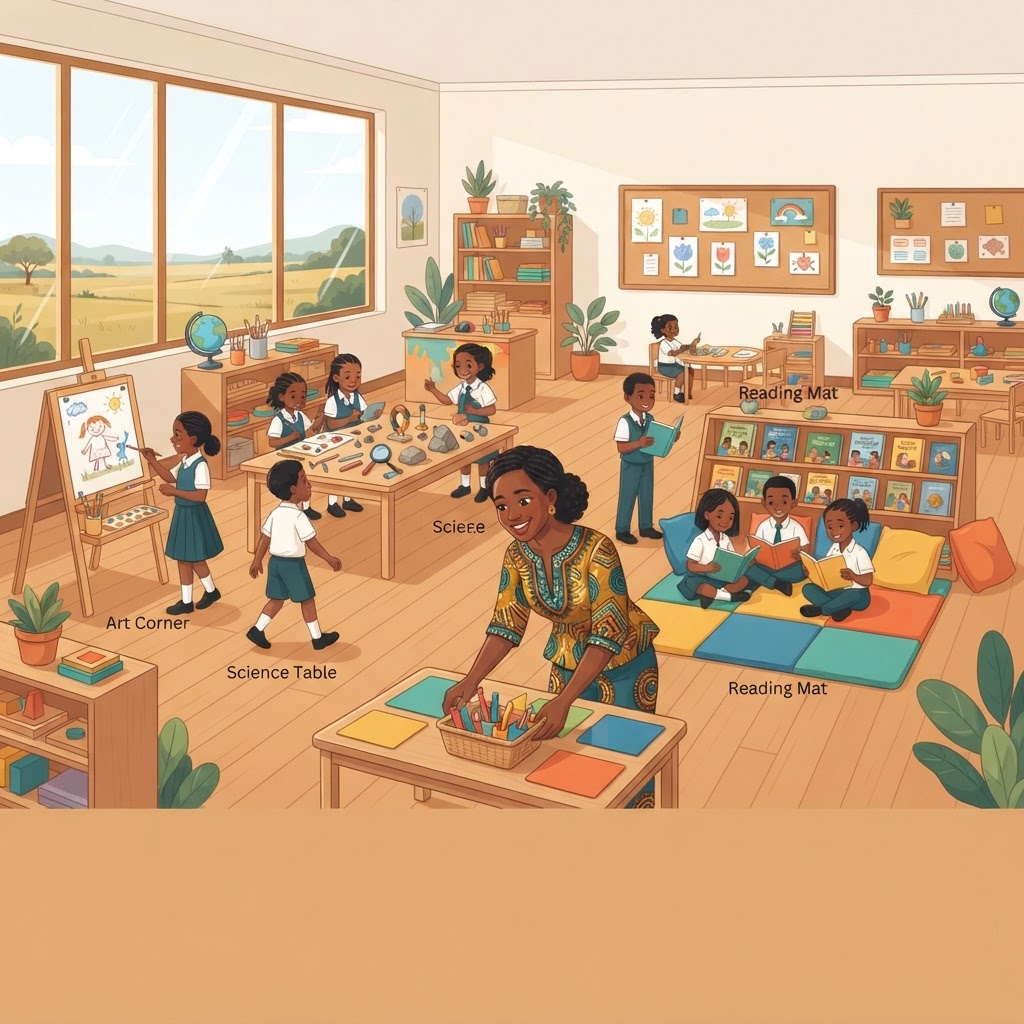
Skip to contentKenyan teacher arranging CBC activity stations in class
teacherteacher

How to Implement CBC in Your Classroom: Teacher Academy Guide

Practical strategies from Nehiju Learn Teacher Academy for implementing CBC in Kenyan classrooms.

By Nehiju Learn··77 views

Share via WhatsApp

Send this to your study group, teacher group, or parent community

Only share useful content. Don't spam.

Implementing CBC in Your Classroom
The Competency-Based Curriculum (CBC) requires a fundamental shift in how educators teach, facilitate, and evaluate learning. This guide summarizes key classroom strategies from the teacher academy nehiju learn kenya program designed for primary and junior secondary school educators.

Shift from Content to Competency

In the traditional 8-4-4 education system, the primary goal was syllabus coverage and rote memorization. Under CBC, the objective is ensuring that learners can actively demonstrate core competencies. This requires teachers to:
  • Focus on what students can DO and apply, rather than what they simply memorize.

  • Design hands-on activities that let students practice, experiment, and showcase skills.

  • Assess through continuous observation, portfolio projects, and presentations alongside written tests.

  • Allow learners to progress according to their individual learning paces.
  • Practical Strategies for CBC Implementation

    ### 1. Start with Learning Outcomes
    Each CBC lesson design must stem directly from clear learning outcomes:
  • Review the Specific Learning Outcomes (SLOs) for the subject strand in the CBC curriculum browser.

  • Design learner-centered activities that directly address these targeted outcomes.

  • Establish clear criteria to determine whether learners have achieved required mastery.
  • ### 2. Use Active Learning Methods
    CBC emphasizes learner-centered pedagogies that keep students engaged:
  • Group Work: Students collaborate on tasks, building teamwork and interpersonal skills.

  • Projects: Learners apply theoretical concepts to real-world community problems.

  • Presentations: Students present findings to peers, developing confidence and communication skills.

  • Practical Activities: Hands-on science experiments and creative tasks enable learning by doing.
  • ### 3. Assess Continuously
    CBC prioritizes formative evaluation over high-stakes end-of-term examinations alone:
  • Observe student performance during group tasks and practical demonstrations.

  • Conduct quick formative quizzes to evaluate real-time concept understanding.

  • Provide constructive feedback that guides students on how to improve.

  • Use the Nehiju Learn quiz engine to generate and grade practice quizzes automatically.
  • ### 4. Integrate Digital Technology
    Leverage digital platform tools to enhance everyday CBC delivery:
  • Assign interactive practice quizzes as homework or revision tasks.

  • Direct students needing extra explanations to Mwalimu AI for support.

  • Distribute revision notes and digital flashcards seamlessly.

  • Monitor class-wide performance metrics using the teacher dashboard.
  • ### 5. Involve Parents as Learning Partners
    CBC explicitly recognizes parents and guardians as co-educators in a child's learning journey:
  • Utilize the Parent Dashboard to share progress updates with families.

  • Recommend Parent Academy courses to help parents understand CBC expectations.

  • Send regular performance summaries to keep parents informed of achievements.

  • Maintain clear communication channels regarding project assignments.
  • Aligning Lesson Planning with KICD Curriculum Designs

    Effective CBC delivery requires alignment with official KICD frameworks across Grade 1 to Grade 9:
  • Strand & Sub-Strand Mapping: Structure schemes of work by breaking down national subject strands (such as Integrated Science or Creative Arts) into clear daily lesson plans.

  • Core Competency Integration: Explicitly embed core CBC competencies — including Critical Thinking, Digital Literacy, and Self-Efficacy — into daily learning tasks.

  • Values & Pertinent Issues: Weave national values and Pertinent and Contemporary Issues (PCIs) into classroom discussions and group activities.
  • Developing Assessment Rubrics for Formative Evaluation

    Formative assessment in CBC relies on clear performance indicators rather than single percentage scores. Teachers should adopt KICD's four-level assessment criteria:
  • Exceeding Expectations (Level 4): The learner consistently demonstrates exemplary understanding and applies skills independently.

  • Meeting Expectations (Level 3): The learner successfully demonstrates all required skills according to expected outcomes.

  • Approaching Expectations (Level 2): The learner displays partial understanding and requires occasional guidance.

  • Below Expectations (Level 1): The learner struggles with core concepts and requires targeted remediation support.
  • Managing CBC Implementation in Resource-Constrained Environments

    Teachers in public primary schools across counties like Nakuru, Kisumu, Kakamega, or Machakos often face large class sizes. Strategies include:
  • Group Rotation: Divide large classes into small collaborative groups where students share digital devices or physical materials.

  • Locally Available Materials: Encourage learners to collect safe, locally sourced materials for science and practical work.

  • Differentiated Support: Use quiz insights from the teacher academy nehiju learn kenya portal to identify learners needing extra support.
  • Preparing Learners for KPSEA and KJSEA Assessment Standards

    As Grade 6 students prepare for KPSEA and Grade 9 students approach KJSEA, teachers play a crucial role:
  • School-Based Assessments (SBA): Maintain accurate records of ongoing SBA projects required by KNEC guidelines.

  • Targeted Practice Quizzes: Use digital practice sets to familiarize students with standardized question formats.

  • Remediation & Review: Use performance analytics to conduct targeted revision sessions on weak sub-strands before national assessment dates.
  • The Full Teacher Academy Course

    The 'Implementing CBC in the Classroom' course offered through the teacher academy nehiju learn kenya platform covers these strategies in depth. Teachers gain access to video tutorials, case studies from Kenyan classrooms, editable lesson plan templates, and practical assessment tools.

    Ready to put this into practice?

    Join the Teacher Academy

    Join the Teacher Academy

    Frequently Asked Questions

    How is CBC assessment different from 8-4-4?

    CBC uses continuous formative assessment (observing students, projects, activities) rather than relying on end-of-term exams. The goal is to see if students can demonstrate competencies, not just recall information.

    Can I use Nehiju Learn quizzes for CBC assessment?

    Yes. Nehiju Learn quizzes are aligned with CBC outcomes. You can assign quizzes to check understanding and use the analytics to identify students who need extra support.

    How do I handle students at different levels?

    The Teacher Academy course on Differentiated Instruction covers this in detail. Key strategies include tiered activities, flexible grouping, and using Nehiju Learn adaptive features to give each student appropriate content.

    Study Notes & Practice Paper — free PDF

    Mwalimu AI turns this article into a complete downloadable study document: key points, definitions, worked examples, an 8-question practice paper with answers, and a revision checklist.

    Free account required — sign up in 30 seconds to download.

    Want more than notes? See plans, from KSh 500 a month

    Free notes PDF for this topic

    Create a free account